#All Star Nodes - Supermon-ng & SkywarnPlus-ng
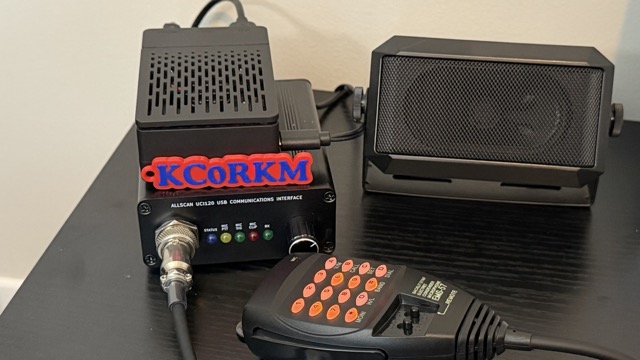
One of the first projects that I worked on was an All Star Node. I had heard about it from the Zero Retries Newsletter by Steve Stroh.
Zero Retries and Steve has turned out to be the Elmer that I don’t have locally for the type of projects I was interested in. We have an active club here in Lawrence, KS. But the members of the club are very much into HF and working the upper bands. They just don’t do a lot of work in VHF and UHF. Which is fine: I’m used to solo projects. And the two projects that I thought I wanted to do first: hot spots. DMR and AllStar.
I ordered the equipment for a DMR hotspot, and actually have it built. But I don’t have a DMR radio yet. So while I am waiting, I was going to pivot and use the equipment for AllStar. And it was then that I found that my radio topper for the Raspberry Pi was digital, and not really usable for analog and All Star. Learning experience.
I stared watching some Youtube videos (Thanks Ham Crusader!). That is when I found that I could build an All Star Node without a radio. I spent quite a bit more time researching which equipment was right for the job. Then waiting for the equipment to arrive.
When it arrived, it was very quick to build. Less than an hour.
The node is a Raspberry Pi 5 running the ALS 3 image from https://www.allstarlink.org. ALS is based on the Astrisk PBX system.
The sound interface is a Allscan UCI120, USB interface that is made by David Gleason in California. He is the also the creater of the Allscan web application for AllStar. The sound interface allows you to add a microphone and speaker to the Raspberry Pi, and makes it very similar to using a radio for your communications.
I have to admit, I had a bit of mic fright when the node was actually ready and usable. There is something about being able to talk on Simplex or the local repeater with your HT. That is enough to scare some people. But when you are connecting to nodes that could be anywhere around the world, its even worse!
So before I keyed the mic, I decided to add some additional softare to the system.
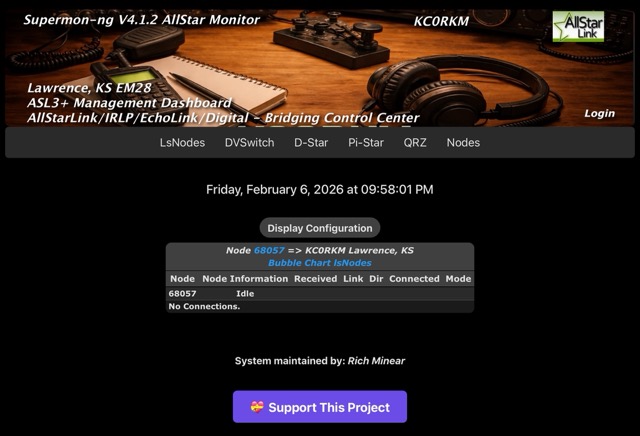
Supermon is a simple web interface (similar to Allscan) that allows you to easily control your Allstar Node. After watching Youtube videos, I installed the software. Easy peasy!
Skywarn Plus is software that can work in conjunction with Supermon and the Allstar Node to provide weather alerts and information on the radio system. And that was right up my alley with the Skywarn volunteering that I do for Douglas County. It wasn’t until I got it installed, but not working, that I found that it was no longer being updated by its creator.
Not to be determined, I found that a new version…a rebuild of the Skywarn Plus system that is named Skywarn Plus NG. But it really wanted to be installed with a rebuild of Supermon: Supermon2 NG. I could not really find any youtube videos on the installation of the software.
Claude AI to the rescue. Claude and I investigated the software, and began the installation. It took about two hours.
I started looking around at AllStar nodes to find some that were busy, and I somehow stumbled upon the Puget Sound Repeater Group. They have a calendar that showed three radio nets…every day! So the very next morning, I connected by node to their net, and started listening. I spent about an hour listening to the cadence of the net, and all of the people who were involved. And decided to try it. They asked for another group of people to list their call signs, and I did. It wasn’t long and I had the mic in my hand and was sharing that I was in Lawrence Kansas, a new Technician licensed ham, and working my first AllStar connection. The response was positive and I was hooked!
Now my mornings are spent listening to different locations around the US. I have some favorites. I’m enjoying the morning drive conversation on the FM38 Repeater group in Wisconsin. Then I can switch to a net from Northern California. I finish the morning with the PSR group in Seattle.
My local club members are very quick to tell me that repeaters are dead. That no one is there. I’m finding that OUR repeater is dead. But there is a very vibrant repeater community in plenty of locations around the US.
And now the world is my oyster. An All Star Oyster.